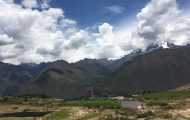
I am working on this poem, first published in Dyn 3 (1942), and I discovered that Jean Piero set it to music in 2023. It is amazing. Jean Piero Díaz Ruiz is in Lima, and he writes poetry as well.
Reviews of The Equestrian Turtle
We’re getting reviewed! There’s a long piece in Full Stop and a shorter review in Action Books. The Chicago Review wants you to review it. And I discovered an amazing site, Surrealist NYC, that’s an inspiring resource. Are there other reviews of LTE, that I haven’t found yet?
César Moro at LASA
I presented on César Moro’s poetry at the May, 2025 meeting of the Latin American Studies Association in San Francisco, and read from our new translation.
I am interested in the ways Moro’s speakers construct a dialogue between self and other, self and world. There is something specific, perhaps Joycean, in the way he works with ego loss.
Reading at NOPF
Esteban Quispe and I read from our translation of The Equestrian Turtle at the New Orleans Poetry Festival on April 12, 2025.
“When you appear the air is immobilized and cruelty armed to the teeth becomes adorable like the plumage of the millenarian birds reflected in your eyes.”
This is a line from “Archaic Reflections on Love,” and I’ve already corrected the translation—or it has already evolved. So may this one, from “The Scandalous Life of César Moro:”
“When the seething ballerinas are at the point of being beheaded / And man grows pale in terrible suspicion of the definitive apparition carrying between his teeth the legible oracle…”
I am planning a new Moro translation project, from his collections Le château de grisou (Firedamp Castle) and Pierre des soleils (Sunstone), and his writings on poetry and art including the essays collected in Los anteojos de azufre (The Sulphur Eyeglasses).
The Equestrian Turtle
Our translation of Peruvian Surrealist César Moro’s collection The Equestrian Turtle is due out from Cardboard House Press in April, 2025. You can pre-order your copy from Asterism Books.
César Moro (Lima, Peru, 1903-1956) was a poet, painter and art critic, and a central figure in the transatlantic avant-gardes of the twentieth century. Living in France for much of the 1920s and 30s and writing in French, he was the only Latin American writer to participate in the original Surrealist movement and contribute to journals like Le surréalisme au service de la Révolution and Violette Nozières.
In Mexico, where he lived from the late 1930s through most of the 40s, he worked with André Breton to create the Fourth International Surrealist Exhibition, collaborated with Wolfgang Paalen on the international Surrealist magazine DYN, and translated writers like Hans Arp, Leonora Carrington, Paul Éluard, and Benjamin Péret.
The Equestrian Turtle is one of the most remarkable poetic collections of twentieth-century Peru and a key Surrealist text. Written in Mexico in 1938-1939 and published in Lima in 1957, The Equestrian Turtle is an oblique chronicle of the love affair Moro had in Mexico with Antonio Acosta, a military man. The critic José Miguel Oviedo observed that the experience of reading this text was as “to dive into a sea full of turtles, lichens and strange fish and emerge to moonlit wanderings on bleak terrain.”
Moro fragments not only perspective but also body and voice in these land and seascapes, or in Oviedo’s words, these “visions of violence and risk, dream and falling,” on which images of Antonio’s body are superimposed. Love is a transfiguration that shatters the self but also establishes a poetic language, and recreates the lovers as non-human actors in a natural world that both crowns and subsumes them.
Reading January 8, 2021
Pedro Granados and I will be reading from Amerindios Friday, January 8, at 7:30 PM Eastern Standard Time, as part of the Jamaica Pond Poets series Chapter and Verse.
CHAPTER AND VERSE LITERARY READING SERIES
Friday, January 8, 2021, 7:30 pm
Poetry in Spanish and Translations
INTO ENGLISH AND INTO MUSIC
Pedro Granados, Lima, Perú, Ph.D. (Hispanic Languages and Literatures), Boston University. Poetry collections: Sin motivo aparente(1978), Juego de manos (1984), Vía expresa (1986), El muro de las memorias (1989), El fuego que no es el sol (1993), El corazón y la escritura (1996), Lo penúltimo (1998), Desde el más allá (2002), Poesía para teatro (2010), Poemas en hucha (2012), Activado (2014), Amerindios (2020), La mirada (2020) and Al filo del reglamento (2020).
Leslie Bary teaches Latin American literature and culture at the University of Louisiana at Lafayette, centering on avant-garde poetics and representations of race, and is a prisoners’ rights activist outside class. Her translation of Oswald de Andrade’s “Manifesto antropófago” has become a classic; English versions of César Moro’s La Tortuga ecuestre and Pedro Granados’ Enredadera are forthcoming. Current writing includes “Border Trouble: Anzaldúa’s Margins” and “Field Notes on the Carceral State: From Death Row to ICE Detention in Louisiana.”
Daisy Novoa Vásquez is a Chilean-Ecuadorian writer passionate about education, the arts, and intercultural understanding. She lives in Jamaica Plain and teaches at the Margarita Muñiz Academy. Daisy contributes to the Hispanic newspaper El Planeta and is the author of the poetry collection Fluir en Ausencia. Many of her writings have been published in print and online anthologies and literary magazines. Daisy was a writer in residence for the University of Massachusetts Boston and has participated in various literary festivals in the U.S., Latin America, and Europe.
Alan Smith Soto, a resident of Jamaica Plain and a member of the Jamaica Pond Poets, was born in San José, Costa Rica. He is the author of three books of poems, Fragmentos de alcancía (Treasure Jar Fragments) (Cambridge: Asaltoalcielo editores, 1998), Libro del lago (Pond poems), (Madrid, Árdora Ediciones, 2014) and Hasta que no haya luna (forthcoming Feb. 2021, Huerga y Fierro Editores, Madrid).His translation of Robert Creeley’s Life and Death (Vida y muerte) was published in 2000 (Madrid: Árdora Ediciones).
Largely unknown today, Juana Borrero (May 17, 1877-March 9, 1896), one of Cuba’s early Modernist poets, delves deep into raw states of imagination, affliction, love, decay, and death, centering the subjective experience of the individual. She died of tuberculosis while in exile in Key West during Cuba’s war for independence at the age of 18.
Stephany Svorinić is a composer and vocalist. Her work has been premiered by the Radius Ensemble and International Contemporary Ensemble, and played on radio stations across the country. She obtained her undergraduate degree from NYU and a Master of Music in vocal performance at New Jersey City University. She graduated from the Longy School of Music in 2019 with a diploma in composition and is currently pursuing a master’s in composition at Tufts University. Her Borrero project sets her translations of the poetry of 19th Century Cuban poet, Juana Borrero, to music.
Poetry by Pedro Granados
With Sasha Reiter and Isaac Goldemberg I translated recent work by Pedro Granados. The book is Amerindios, and it is available now.
This is one of the more successful translations, I think:
To see someone age
Like a style, like a song
Like a movie that at the exit
Left you remains of inspiration
Strength pride
Isn’t nearly what you’ll feel later
Before the head tilts down
And the breath subsides
And you don’t believe what you see
And even less what you’re doing:
Laying the body out
And joining hands that seem distant
While her heart still watches you.
Between time past
And the farthest future
Hanging on
Turn-sick amid what we are
And what our mother is
And her piston
And the carousel of her arms
To look
In distraction and suffering
Through what is mine all my own
Or in disquiet
At an open hand
A butterfly or hummingbird
Flutters around us and makes us laugh
I’m writing but not to you
It’s redundant
I’m repairing the umbilical cord
That’s broken
And buried
And to this I stick
Because it’s how things are going
And because I’ve come to old age
My dog all restless
Scrutinizes my head
Puts his ear to my gaze
Auscultates my tears
Calms down finally
Moves his tail softly
And vanishes like a lizard
Dordor Gallery
My cousin Ilya Fedorov has opened a gallery in Brooklyn, the Dordor Gallery. He exhibits and sells his own and other painting, and rents studio space. There is a café, an event venue and more. Artists who join receive a series of benefits.
The gallery mirrors and takes up the work it had done in Moscow until being shut down last year.
Amerindios/Amerindians
Eminent Peruvian-American writer Isaac Goldemberg, poet Sasha Reiter and I have translated a book of poetry by Pedro Granados, forthcoming 2020 from Artepoética Press in New York. The volume includes work from two prior collections, Roxosol and Activado. I’ll be reading from it at the New Orleans Poetry Festival April 19.
Update: The Poetry Festival was postponed until 2021 due to the COVID-19 situation. I hope to see everyone then.
Turquoise plate

This is decorative but can be used for serving, too. When I glazed it I was thinking of Persian work. I would like to create a still more Persian blue.
 Leslie Bary Arts and Letters